10 Things to Know About Car Safety In India (2026): The Ultimate Guide
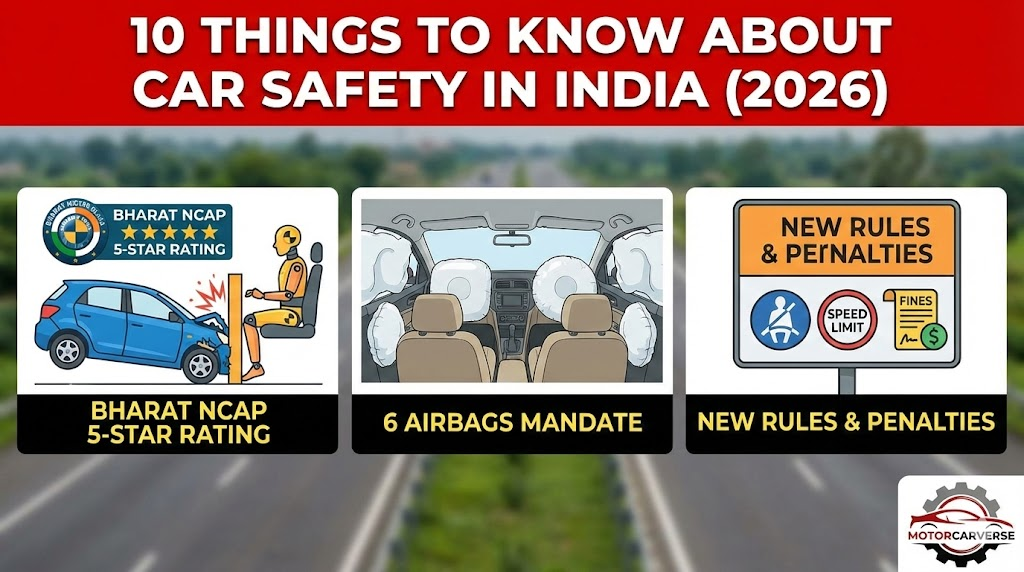
The definition of a “good car” in India has shifted dramatically. A few years ago, it was all about “Kitna deti hai?” (How much mileage does it give?). Today, the first question savvy buyers ask is, “Is it a 5-star rated car?” Top 10 Safest Cars in India – Safety Ratings & Features
As we navigate through 2026, the Indian automotive safety landscape has undergone a massive transformation. With the full-fledged implementation of Bharat NCAP, strict government mandates on seatbelt reminders, and the democratization of advanced tech like ADAS, Indian roads are witnessing safer cars than ever before.
At MotorCarVerse, we believe an informed buyer is a safe buyer. Here are the 10 essential things you must know about car safety in India in 2026.
1. Bharat NCAP is Now the Gold Standard
Gone are the days when we relied solely on Global NCAP results from Germany. Bharat NCAP (BNCAP) is now fully operational and is the official safety rating agency for India.
- The Test: It crashes cars at 64 km/h (frontal offset) and 50 km/h (side impact), similar to global standards.
- The Impact: Manufacturers are voluntarily lining up to get the “BNCAP 5-Star” badge because it translates directly to sales. Cars like the Tata Harrier EV, Tata Punch, and Mahindra XEV 9e have already set benchmarks with top scores.
- The Future: A stricter “Bharat NCAP 2.0” is already in the drafting stage, potentially adding rear-impact tests by 2027.
2. The “6 Airbags” Rule: Mandate vs. Market Reality
There has been confusion regarding the “6 Airbags Mandate.” Let’s clear it up for 2026.
- The Rule: The government’s draft notification to legally mandate 6 airbags for all cars lapsed and was not made compulsory to avoid pricing entry-level cars out of reach.
- The Reality: Despite not being a law, Market Forces have made it a standard. To achieve a 5-star rating in Bharat NCAP, having 6 airbags is virtually essential. Consequently, automakers like Hyundai and Kia have standardized 6 airbags across all variants, even in budget cars like the Grand i10 Nios.
3. Rear Seat Belt Alarms Are Now Mandatory
Effective from April 1, 2025, the Indian government mandated Rear Seat Belt Reminders for all new cars.
- How it works: If a rear passenger is seated but not buckled up, the car will sound a continuous alarm, just like it does for the front seats.
- Why it matters: Rear seat passengers are often the most vulnerable in high-speed crashes. This annoying beep is a lifesaver designed to force compliance.
4. ADAS Level 2 is the New “Power Window”
Advanced Driver Assistance Systems (ADAS) was once a luxury feature for Volvos and Mercedes. In 2026, it is a mainstream feature available in cars under ₹10 Lakhs!
- What you get: Features like Automatic Emergency Braking (AEB), Lane Keep Assist, and Adaptive Cruise Control.
- Affordable Heroes: Cars like the Mahindra XUV 3XO, Hyundai Venue, and Honda City now offer ADAS Level 2, making active safety accessible to the masses.
5. Electronic Stability Control (ESC) is Non-Negotiable
If you are buying a car in 2026, ensure it has ESC (Electronic Stability Control).
- The Shift: While ABS (Anti-lock Braking System) prevents wheel lockup, ESC prevents skidding and loss of control during sudden maneuvers.
- BNCAP Requirement: ESC is a mandatory requirement for a car to be eligible for a higher star rating in Bharat NCAP. Most manufacturers now offer it as standard from the base variant.
6. Pedestrian Safety Norms Have Tightened
It’s not just about the people inside the car. New safety norms focus on the people outside it.
- Design Changes: You will notice newer cars have slightly softer, more upright bonnets and redesigned bumpers. This is to comply with pedestrian protection norms that minimize injury to the head and legs of a pedestrian in case of a low-speed impact.
- Supreme Court Directive: States are now under strict orders to enforce pedestrian-friendly road designs, putting pressure on city planning alongside vehicle design.
7. ISOFIX: Child Safety Takes Center Stage
For families, ISOFIX mounts are no longer a “nice-to-have”; they are a must-have.
- What is it? A standardized international anchoring system to secure child seats directly to the car’s chassis, rather than using a seatbelt.
- The Trend: Almost all BNCAP 5-star rated cars come with ISOFIX mounts as standard. If you have a child, this feature is non-negotiable for their safety.
8. Connected Car Tech = Faster Rescue
Safety in 2026 is also digital. Connected Car Technology (offered as Kia Connect, Hyundai Bluelink, Suzuki Connect, etc.) includes vital safety features:
- e-Call (Emergency Call): In the event of an airbag deployment, the car automatically calls emergency services with your GPS location.
- Geo-Fencing: Alerts you if your car leaves a designated area (useful for parents handing cars to teenagers).
9. “Stable Body Shell” is the Buzzword
You will hear car reviewers use the term “Stable Body Shell” often.
- Meaning: It means the passenger cabin did not deform significantly during the crash test, leaving space for survival.
- The Check: A car can have 6 airbags but an unstable body shell (like older budget hatchbacks). Always check the crash test report to see if the Bodyshell Integrity is rated as “Stable.”
10. Aftermarket Mods: What is Legal vs. Unsafe
Modifying cars is a passion, but 2026 regulations are strict about safety compromises.
- Illegal: Bull bars (crash guards) are strictly banned as they prevent airbag sensors from working and harm pedestrians.
- Illegal: Tinted windows (below 70% visibility) and modifying the chassis structure.
- Legal: Upgrading tyres (within limits), headlights (if RTO compliant), and adding dashcams (highly recommended for insurance claims).
Safety Feature Checklist for 2026 Buyers
If you are buying a new car this year, use this checklist to ensure you are getting a safe vehicle:
| Feature | Importance | Status in 2026 |
| Airbags | Critical | 6 Airbags recommended (Standard in many models) |
| ABS + EBD | Basic | Mandatory Standard |
| ESC | Critical | Standard in 5-Star Cars |
| Rear Seat Belt Alarm | Mandatory | Required in all new cars post-April 2025 |
| ISOFIX Mounts | High | Standard in safest cars |
| ADAS Level 2 | High | Available in top trims of compact SUVs |
| Tyre Pressure Monitor | Medium | Common in mid-spec variants |
| 360-Degree Camera | Convenience | Popular in premium hatchbacks & SUVs |
Conclusion: Safety is a Choice
In 2026, the Indian consumer is the biggest winner. You no longer have to pay a premium for safety; it is available in a ₹6 Lakh Tata Punch just as it is in a ₹30 Lakh Jeep Meridian.
When you walk into a showroom today, look beyond the sunroof and the touchscreen. Ask for the Bharat NCAP rating, check for 6 airbags, and ensure ESC is on the spec sheet. Your family’s safety is worth every rupee.
Frequently Asked Questions (FAQs)
1. Is it mandatory to have 6 airbags in cars in India in 2026?
No, it is not legally mandatory for all cars to have 6 airbags. The government proposal lapsed. However, most manufacturers are voluntarily making 6 airbags standard to achieve 5-star safety ratings.
2. What is the penalty for not wearing a rear seat belt in India?
Under the Motor Vehicles Act, the penalty for not wearing a seat belt (including in the rear seat) is ₹ 1,000. With mandatory rear seat belt alarms in new cars, enforcement is stricter.
3. Which is safer: Global NCAP or Bharat NCAP?
Both are highly credible. Bharat NCAP is tailored for Indian regulations but follows protocols very similar to Global NCAP (crash speeds of 64 km/h). A 5-star rating in either indicates a very safe vehicle.
4. Can I install a bull bar on my car for safety? No.
Installing bull bars or metal crash guards is illegal in India. They interfere with airbag sensors, preventing deployment during a crash, and cause severe injury to pedestrians.
5. Which is the cheapest car with ADAS Level 2 in India?
As of early 2026, the Mahindra XUV 3XO and Hyundai Venue offer ADAS Level 2 features in their higher variants, priced around ₹ 12-13 Lakhs (ex-showroom).
Disclaimer: Rules and regulations are subject to change by the Ministry of Road Transport and Highways (MoRTH). Always refer to the latest government notifications for legal compliance.
