Hyundai is getting ready to add another SUV to its Indian line-up, and this time the name is Hyundai BAYON.
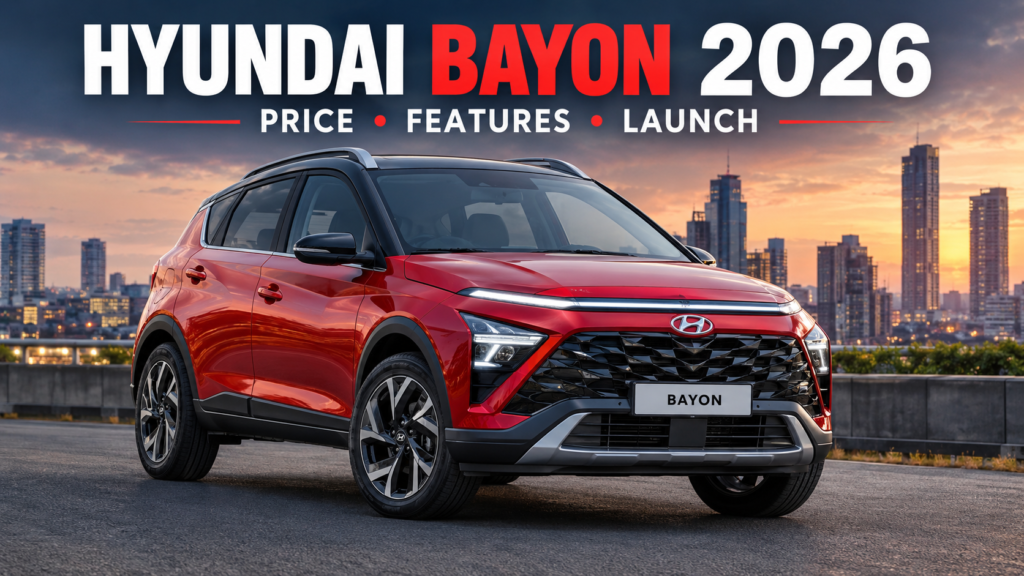
The upcoming Hyundai Bayon has already generated significant interest among Indian car buyers because it will sit between the Hyundai Venue and Hyundai Creta, giving Hyundai another SUV in one of the country’s most competitive price segments. Honda Elevate Facelift 2026: Launch Date, Price, Features & Changes
The company has officially confirmed the Bayon name, revealed its design direction, opened bookings and announced several important details. Hyundai says the SUV will feature an in-built generative AI voice assistant, a petrol powertrain with manual and IVT transmission options, and a platform engineered for 5-star Indian safety standards.
Hyundai has not yet announced the final launch date or official variant-wise prices. However, industry reports currently point towards a mid-to-late October 2026 launch, making the Bayon one of the most interesting festive-season SUV launches in India.
So, what exactly can buyers expect?
Hyundai Bayon India 2026: Quick Overview
| Particular | Hyundai Bayon India 2026 |
|---|---|
| Launch | Expected mid-to-late October 2026 |
| Booking amount | ₹11,000 |
| Segment | Compact/mid-size SUV |
| Seating | 5 passengers |
| Length | Around 4.2 metres |
| Platform | Global K Enhanced Platform |
| Fuel | Petrol |
| Transmission | Manual + IVT |
| CNG | Reported, but not officially confirmed by Hyundai |
| Price | Expected around ₹9–14 lakh ex-showroom |
| Positioning | Between Venue and Creta |
| Key technology | Generative AI voice assistant |
| Safety focus | Platform engineered for 5-star Indian safety standards |
Important: The official price, launch date and complete variant-wise feature list are still awaited. Expected figures in this article are clearly identified as estimates.
Hyundai Bayon Launch Date in India
Hyundai has confirmed that the Bayon is coming during the festive season, but the company has not yet publicly announced an exact launch date.
Bookings officially opened on September 23, 2026, and customers can reserve the SUV through Hyundai’s website or authorised dealerships by paying ₹11,000. Hyundai says the delivery timeline will be communicated at the time of launch.
Current industry information puts the launch in the mid-to-late October 2026 window. Autocar India currently lists the Bayon launch as late October, while other automotive databases have used estimated dates within October.
For buyers, this means one thing: the Bayon is no longer just an upcoming project. Hyundai has already started accepting bookings.
Hyundai Bayon Price in India
Hyundai has not announced the official Bayon price yet.
Current industry estimates place the new SUV in approximately the ₹9 lakh to ₹14 lakh ex-showroom range.
That expected pricing would allow Hyundai to position the Bayon between its existing Venue and Creta while giving customers another option in the increasingly crowded compact and midsize SUV market.
Expected Hyundai Bayon price
| Variant positioning | Expected price |
|---|---|
| Entry variant | Around ₹9 lakh |
| Mid variants | ₹10–12 lakh |
| Higher variants | ₹12–14 lakh |
These figures are not official Hyundai prices.
The final price will be particularly important because the Bayon will face strong competition from products such as the Maruti Brezza, Tata Nexon, Kia Sonet, Hyundai Venue, Maruti Fronx and other SUVs in overlapping price brackets.
Why Is Hyundai Launching the Bayon in India?
Hyundai already has the Venue and Creta, so why add another SUV?
The answer is simple: India’s SUV market is increasingly divided into multiple price and size categories.
The Venue targets buyers looking for a compact SUV, while Creta serves customers looking for a larger and more premium midsize SUV.
The Bayon gives Hyundai an additional product between those two models.
Hyundai has confirmed that the Bayon is approximately 4.2 metres long, giving it a larger footprint than the traditional sub-4-metre compact SUV formula while still maintaining a relatively city-friendly size.
This could make the Bayon appealing to buyers who think the Venue is slightly too small but don’t necessarily want to move all the way up to a Creta.
Hyundai Bayon Design: What Does It Look Like?
Hyundai is positioning the Bayon as an SUV with a futuristic and technology-focused identity.
The company has officially shown design sketches and teaser images highlighting its new “Art of Steel” design language. Hyundai says the SUV combines architectural forms, sharp character lines and confident proportions to create a strong road presence.
The official design information highlights several important styling elements.
Front design
The Bayon features:
- Sculpted bonnet
- Futuristic front fascia
- Signature H-Edge LED DRLs
- Wide SUV stance
- Geometric wheel arches
Hyundai says the lighting and front-end treatment are designed to give the SUV a distinctive road presence.
The front lighting is particularly important because Hyundai has been moving towards more distinctive LED signatures across its latest products.
Hyundai Bayon Side Profile
From the side, Hyundai has emphasised a sporty and dynamic proportion.
The SUV gets:
- Geometric wheel arches
- Wrap-around door cladding
- Bridge-type roof rails
- Strong character lines
- Rising window-line treatment
Hyundai describes the design as combining athletic proportions with sophisticated detailing.
The overall result appears to be a more crossover-like SUV rather than a boxy traditional utility vehicle.
This could help the Bayon appeal to younger urban buyers who want the visual presence of an SUV without moving to a much larger vehicle.
Hyundai Bayon Rear Design
The rear design follows the same futuristic approach.
The teaser images show a distinctive LED lighting signature and a sculpted tail section.
Hyundai’s design sketches emphasise sharp rear proportions and connected visual elements that make the Bayon look wider than its actual dimensions.
The design is one of the areas where the Bayon could differentiate itself from more conventional rivals such as the Brezza and Nexon.
Hyundai Bayon Interior
The cabin is expected to be one of the Bayon’s biggest selling points.
Hyundai’s official design material describes the interior philosophy as a high-tech interior within a tough exterior.
The interior design sketches show a modern dashboard with a digital cockpit-style layout, and industry reports indicate that the India-spec SUV could feature a curved dual-screen arrangement and a dashboard influenced by Hyundai’s latest global products.
Expected highlights include:
- Digital driver display
- Large infotainment screen
- Connected-car technology
- Modern dashboard design
- Premium cabin materials
- Multifunction steering wheel
- Advanced voice functions
- Enhanced convenience features
The final variant-wise equipment list is still to be announced.
Hyundai Bayon Gets Generative AI Voice Assistant
One of the most interesting confirmed features is Hyundai’s in-built generative AI voice assistant.
This isn’t simply a normal voice-command system.
Hyundai says the Bayon is designed around its “Intelligence That Moves” philosophy and that the integrated generative AI assistant is intended to provide a more natural and intuitive interaction with the vehicle.
This could allow drivers to interact with vehicle functions and connected services in a more conversational way.
The feature is particularly interesting because Hyundai is trying to position the Bayon not just as another SUV, but as a technology-focused intelligent utility vehicle.
That could become one of the major marketing points for the SUV.
Hyundai Bayon Engine and Transmission
Hyundai has officially confirmed that the India-spec Bayon will use a petrol powertrain and will be available with both a manual transmission and Hyundai’s IVT automatic transmission.
However, Hyundai has not yet published the complete engine specification, including final displacement, output and torque figures.
Industry reports have suggested that the SUV could use Hyundai’s 1.5-litre naturally aspirated petrol engine, with reports also pointing towards a CNG version.
Until Hyundai confirms those details officially, buyers should treat the exact engine configuration as expected rather than confirmed.
Current confirmed powertrain information
Fuel: Petrol
Manual: Yes
Automatic: IVT
Diesel: Not announced
Hybrid: Not announced
Will Hyundai Bayon Get CNG?
This is one of the most interesting questions surrounding the new SUV.
Several reports have indicated that Hyundai is preparing a factory-fitted CNG version, potentially making the Bayon one of the few larger SUVs in its price range to offer a CNG option. Some reports also suggest an underbody CNG tank layout.
However, Hyundai’s official booking announcement currently only confirms a petrol powertrain with manual and IVT options and does not officially list CNG in its announced powertrain information.
Therefore:
CNG should currently be treated as a reported upcoming option, not a confirmed launch specification.
This distinction matters because many online articles have already started presenting the CNG version as confirmed.
Motorcarverse will update this section once Hyundai makes the official announcement.
Hyundai Bayon Mileage
Official ARAI mileage figures have not yet been announced.
Because Hyundai has not published the final powertrain specifications or variant-wise details, it would be premature to quote a definitive mileage figure.
For the petrol version, real-world mileage will depend on:
- Engine configuration
- Transmission
- Traffic
- Driving style
- Vehicle load
- Tyre pressure
- Road conditions
The potential CNG version, should Hyundai officially introduce it, would obviously be aimed at buyers prioritising lower running costs.
Rather than publishing an unsupported mileage number, buyers should wait for the final ARAI certification.
Hyundai Bayon Safety Features
Safety is another major focus area for the new SUV.
Hyundai says the Bayon is built on the Global K Enhanced Platform, which has been engineered for 5-star Indian safety standards.
There is an important distinction here:
“Engineered for 5-star Indian safety standards” does not automatically mean the vehicle has already received a 5-star crash-test rating.
Until an official crash-test result is published, the Bayon should not be described as a certified 5-star vehicle.
Hyundai says the SUV has been developed with a focus on:
- Occupant protection
- Structural rigidity
- Advanced safety engineering
- Modern driver-assistance and safety technologies
The complete variant-wise safety equipment list is expected closer to launch.
Hyundai Bayon Features: What to Expect
Although the complete brochure has not yet been released, Hyundai has already confirmed its focus on intelligence, safety, comfort, performance and styling.
Expected or announced equipment includes:
Technology
- Generative AI voice assistant
- Digital displays
- Connected-car technology
- Smart infotainment functions
Comfort
- Premium cabin
- Modern dashboard
- Intelligent space utilisation
- Good headroom and legroom
Exterior
- H-Edge LED DRLs
- Sculpted bonnet
- Geometric wheel arches
- Wrap-around cladding
- Bridge-type roof rails
- Distinctive LED lighting
Safety
- Global K Enhanced Platform
- Structural safety focus
- Advanced safety technologies
- Multiple safety systems depending on variant
More detailed equipment such as panoramic sunroof, 360-degree camera, ventilated seats and ADAS should only be listed as confirmed after Hyundai publishes the final specification sheet.
Hyundai Bayon Dimensions
Hyundai has officially stated that the Bayon is approximately 4.2 metres long.
That makes it an interesting proposition because its dimensions place it above the typical sub-4-metre compact SUV category while keeping it considerably smaller than many large SUVs.
Expected positioning
Venue: Smaller, city-focused compact SUV
Bayon: Approximately 4.2-metre SUV
Creta: Larger midsize SUV
The Bayon could therefore occupy an unusual but potentially valuable space in Hyundai’s portfolio.
Hyundai Bayon vs Hyundai Venue
The closest internal comparison will be with the Venue.
| Feature | Hyundai Bayon | Hyundai Venue |
|---|---|---|
| Positioning | Between Venue & Creta | Compact SUV |
| Length | ~4.2m | Sub-4m |
| Petrol | Yes | Yes |
| Manual | Confirmed | Yes |
| Automatic | IVT confirmed | AT/DCT options depending variant |
| Technology | AI voice assistant | Connected technology |
| Target buyer | More space + SUV presence | Urban compact SUV |
The Bayon should appeal to buyers who want something larger and more spacious than a Venue but don’t need the size or price of a Creta.
Hyundai Bayon vs Hyundai Creta
Hyundai will have an interesting challenge because the Bayon could overlap with the lower end of Creta territory.
The Creta starts at a significantly higher position in Hyundai’s current SUV range, while the Bayon is expected to begin around ₹9 lakh according to current industry estimates.
This gives Hyundai a two-model approach:
Bayon → price-conscious midsize SUV buyer
Creta → premium midsize SUV buyer
This strategy could help Hyundai cover a wider portion of the market.
Hyundai Bayon vs Maruti Brezza
The Maruti Suzuki Brezza is likely to be one of the Bayon’s most important rivals.
The Brezza has several advantages, particularly its established customer base, wide service network, compact dimensions and CNG availability.
The Bayon could counter with:
- Larger overall footprint
- More futuristic styling
- Hyundai’s technology package
- Generative AI voice assistant
- IVT automatic
- More premium positioning
The final comparison will depend heavily on Bayon’s price and official equipment.
Hyundai Bayon Expected Rivals
Depending on its final pricing, the Bayon could compete with:
- Maruti Brezza
- Tata Nexon
- Kia Sonet
- Hyundai Venue
- Maruti Fronx
- Kia Syros
- Maruti Victoris
- Some lower variants of the Hyundai Creta
The exact competitive set will become clearer once Hyundai announces the final price.
Who Should Consider the Hyundai Bayon?
The Bayon could make the most sense for buyers who want:
More space than a compact SUV
A roughly 4.2-metre footprint should provide a larger cabin proposition than typical sub-4-metre SUVs.
Modern technology
The integrated generative AI voice assistant gives the Bayon a distinctive technology angle.
Automatic convenience
Hyundai is confirming an IVT automatic, which should be particularly useful for city driving.
SUV styling
The Bayon’s design is clearly more crossover/SUV-focused than a conventional hatchback.
A new-generation product
Buyers who don’t want to purchase an ageing model may prefer a completely new product such as the Bayon.
Who Should Wait Before Booking?
If you are considering the Bayon right now, there are still some important unanswered questions.
These include:
- Final price
- Variant names
- Exact engine specification
- ARAI mileage
- Complete safety equipment
- ADAS availability
- 360-degree camera availability
- Sunroof specification
- Ventilated-seat availability
- Exact CNG launch timing
The ₹11,000 booking amount gets customers into the reservation process, but the final purchasing decision should ideally be made after Hyundai releases the full specification and pricing.
Is Hyundai Bayon Better Than Creta?
It would be too early to say.
The two SUVs are designed for slightly different buyers.
The Bayon should focus more heavily on:
value + technology + urban practicality
while the Creta remains the more established midsize SUV with a broader range of powertrain and premium-equipment choices.
For buyers with a budget close to ₹10–12 lakh, the Bayon could potentially be the better-value proposition.
For buyers willing to spend considerably more for a larger, more premium SUV, the Creta will continue to make sense.
Hyundai Bayon 2026: Confirmed vs Expected
| Detail | Status |
|---|---|
| Hyundai Bayon name | ✅ Confirmed |
| India launch | ✅ Confirmed |
| Festive-season arrival | ✅ Confirmed |
| Bookings | ✅ Open |
| Booking amount | ✅ ₹11,000 |
| Petrol engine | ✅ Confirmed |
| Manual gearbox | ✅ Confirmed |
| IVT automatic | ✅ Confirmed |
| ~4.2m length | ✅ Confirmed |
| Generative AI voice assistant | ✅ Confirmed |
| Global K Enhanced Platform | ✅ Confirmed |
| Engine displacement | ⚠️ Not officially specified |
| CNG | ⚠️ Reported, not officially confirmed |
| Official mileage | ⏳ Awaited |
| Official price | ⏳ Awaited |
| Exact launch date | ⏳ Awaited |
| 360-degree camera | ⏳ Awaited |
| ADAS | ⏳ Variant details awaited |
| Crash-test rating | ⏳ Not yet established |
Final Verdict
The Hyundai Bayon India 2026 could become one of the most important new Hyundai launches of the year.
Rather than simply adding another compact SUV, Hyundai is using the Bayon to create a new position between the Venue and Creta.
The combination of a roughly 4.2-metre SUV body, modern styling, IVT automatic, advanced connectivity and a generative AI voice assistant gives the Bayon a distinctive proposition. Hyundai is also putting significant emphasis on safety and says the platform is engineered for 5-star Indian safety standards.
The biggest unanswered question is price.
If Hyundai manages to keep the starting price close to the expected ₹9–10 lakh region while offering competitive equipment, the Bayon could put serious pressure on the Brezza, Nexon, Sonet and other SUVs.
But buyers should wait for the official variant-wise pricing before deciding.
Motorcarverse Verdict:
The Hyundai Bayon could be Hyundai’s most interesting new SUV for value-conscious buyers in 2026, but its final price and feature list will determine whether it actually becomes a segment game-changer.
Frequently Asked Questions
What is the Hyundai Bayon?
The Hyundai Bayon is a new SUV being introduced in India as an additional model between the Venue and Creta. Hyundai calls it an Intelligent Utility Vehicle.
When will the Hyundai Bayon launch in India?
Hyundai has confirmed that the Bayon is coming during the 2026 festive season, while current industry reports point towards a mid-to-late October launch.
What is the Hyundai Bayon booking amount?
Hyundai has opened bookings for ₹11,000 through its website and authorised dealerships.
What is the expected Hyundai Bayon price?
Current industry estimates place the Bayon at around ₹9 lakh to ₹14 lakh ex-showroom, but Hyundai has not announced the official price yet.
Does the Hyundai Bayon have an automatic gearbox?
Yes. Hyundai has confirmed an IVT automatic transmission in addition to a manual gearbox.
Will Hyundai Bayon come with CNG?
Several industry reports indicate that a CNG version could be introduced, but Hyundai’s official booking announcement currently confirms only the petrol powertrain. Therefore, the CNG version should be considered unconfirmed until Hyundai announces it officially.
Is Hyundai Bayon a 5-star safety-rated car?
Not yet. Hyundai says the platform is engineered for 5-star Indian safety standards, but that statement should not be treated as an official 5-star crash-test result.
How long is the Hyundai Bayon?
Hyundai officially describes the India-spec Bayon as approximately 4.2 metres long.
