Nissan Tekton SUV: The Japanese Warrior Returns to Challenge the Creta and Sierra
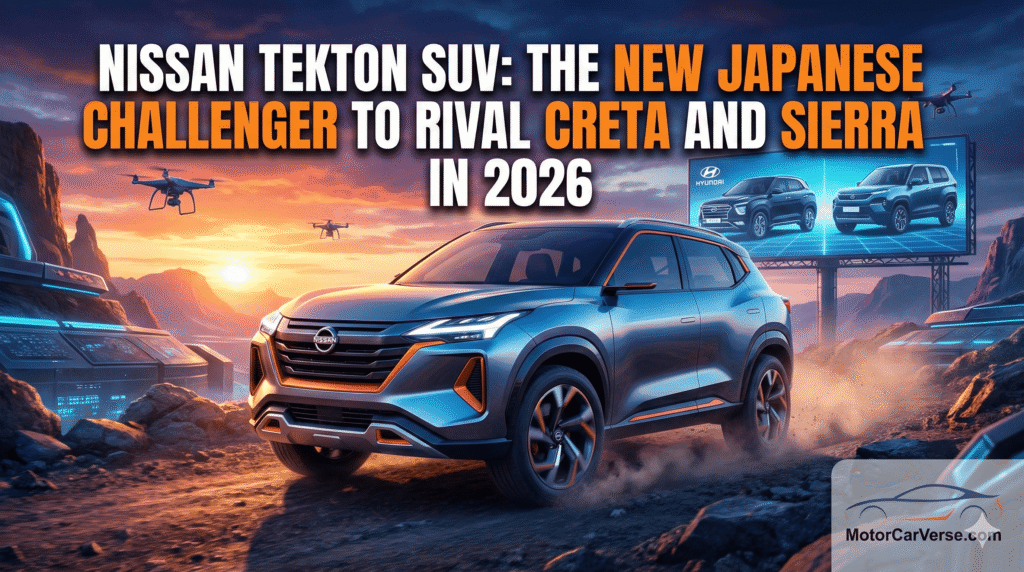
The Indian mid-size SUV segment is essentially a battlefield. For years, the Hyundai Creta has sat on the throne, virtually unchallenged in its sales dominance. The Kia Seltos put up a strong fight, and recently, the Maruti Grand Vitara and Toyota Hyryder have carved out their own slice of the pie. But the year 2026 promises to be different. The segment is about to get a heavy dose of nostalgia mixed with futuristic tech. We already know the legendary Tata Sierra is making a comeback, but there is another player entering the ring—a Japanese samurai that has been sharpening its blade in the shadows. Mahindra XUV 7XO Launching Tomorrow: India’s Favorite 7-Seater SUV Gets a Mega Upgrade!
Enter the Nissan Tekton.
Nissan, a brand that has kept its Indian operations afloat almost single-handedly with the success of the Magnite, is finally gearing up for its “Big Bang” moment. Expected to be unveiled in February 2026, the Nissan Tekton is not just another SUV; it is a strategic strike against the established order. Sharing its DNA with the upcoming Renault Duster but promising a unique Japanese flair, the Tekton is poised to be the disruption the market has been waiting for. Here is everything you need to know about the SUV that aims to undercut the Creta and outshine the Sierra.
The Resurrection of Nissan India
To understand the significance of the Tekton, we must first look at Nissan’s journey. After the discontinuation of the Kicks and the Terrano, Nissan’s showroom floor has looked rather empty, save for the valiant Magnite. The Magnite proved one crucial thing: Nissan knows how to package a car for India. They offered punchy engines, great features, and killer looks at a price point that made rivals sweat.
The Nissan Tekton is expected to follow this exact philosophy but on a much grander scale. This is not a sub-4-meter compromise; this is a proper, 4.3-meter-plus C-segment SUV designed to offer the road presence of a Duster with the sophistication of a Japanese tourer. With the Renault-Nissan-Mitsubishi alliance strengthening its localized CMF-B platform, the Tekton represents the next chapter for Nissan in India—a chapter defined by premium aspirations and aggressive market positioning.
Design Philosophy: Sharp, Sleek, and Japanese
While the Nissan Tekton will share its underpinnings (chassis and engine) with the 2026 Renault Duster, do not make the mistake of thinking it will be a simple “badge-engineering” job like the Terrano was to the old Duster. Reports and teasers indicate that the Tekton will wear a completely distinct suit.
The Front Fascia Where the Duster is boxy, rugged, and utilitarian, the Nissan Tekton is expected to be sharper and more aerodynamic. We anticipate an evolution of Nissan’s V-Motion grille, likely frameless and integrated with sleek LED Daytime Running Lights (DRLs). The headlamps will likely be slimmer than the Duster’s, giving it a more urban, high-tech look. Think of it as the difference between a hiking boot (Duster) and a high-performance running shoe (Tekton).
Side Profile and Stance The silhouette will undoubtedly be muscular. Expect prominent wheel arches, but perhaps with body-colored cladding on higher trims to emphasize a premium “City SUV” vibe compared to the Duster’s heavy black plastic armor. The roofline might feature a “floating roof” effect, a design trait popularised by Nissan globally. Alloy wheel designs will be diamond-cut, likely 17 or 18 inches, filling the arches well to ensure a commanding stance against the Tata Sierra.
Interior & Cabin Experience: A Tech-Forward Lounge
If you are buying a car in 2026, the interior is where the deal is closed. The Hyundai Creta set the benchmark for interiors, and the Tata Sierra is promising a “lounge-like” experience. Nissan has to bring its A-game.
Dashboard and Layout Teasers suggest a dashboard that prioritizes horizontal lines and sleek integration. Unlike the rugged, blocky interior expected in the Duster, the Tekton will likely feature soft-touch materials, a layered dashboard design, and ambient lighting that runs across the width of the cabin. The aim is to feel “expensive.”
Space and Practicality One area where Nissan never fails is space management. The Magnite is a cavern for its size, and the Tekton will inherit the Duster’s famously practical packaging. Expect class-leading shoulder room and a wheelbase that ensures ample legroom for rear passengers. Nissan might also introduce “Zero Gravity” seats—a technology they use globally to reduce fatigue on long drives—which would be a massive selling point against the firm seats of the German and Korean rivals.
The Feature List: Loaded to the Gills
To rival the Creta and the tech-heavy Tata Sierra, the Nissan Tekton cannot afford to be sparse. Based on the platform’s capabilities, here is the expected arsenal of features:
- Infotainment: A floating 10-inch or larger touchscreen infotainment system with a slick interface.
- Connectivity: Wireless Android Auto and Apple CarPlay will be standard on mid-to-high variants.
- Digital Cockpit: A 7-inch or fully digital instrument cluster with customizable graphics.
- 360-Degree Camera: A feature Nissan popularized in India; expect high-resolution cameras to help navigate tight parking spots.
- Panoramic Sunroof: A non-negotiable feature for Indian buyers in this segment.
- Ventilated Seats: Crucial for the Indian climate.
- Safety Tech: The Tekton is expected to feature Level 2 ADAS (Advanced Driver Assistance Systems), including features like Autonomous Emergency Braking, Lane Keep Assist, and Adaptive Cruise Control.
Engine & Performance: The Return of the “Merc” Engine
This is the most exciting part for enthusiasts. The Nissan Tekton is expected to borrow the powertrain that puts the “Sport” in SUV.
The 1.3L Turbo Petrol The headline act will likely be the 1.3-litre Turbo Petrol engine. This is no ordinary engine; it was co-developed with Daimler (Mercedes-Benz) and has powered cars like the Mercedes A-Class and the GLA.
- Power: Expect around 156 bhp (158 PS).
- Torque: A massive 254 Nm.
To put this in perspective, this makes the Tekton significantly more powerful than the standard naturally aspirated engines in the Creta and Grand Vitara. It puts it squarely in competition with the Creta N-Line and the 1.5 Turbo variants of the Seltos. This engine is a gem—refined at low speeds but an absolute rocket when the turbo spools up.
Transmission Options We expect a 6-speed Manual for the purists and a quick-shifting CVT or DCT automatic for urban commuters. Nissan’s CVT technology (X-Tronic) is among the best in the business, offering smooth power delivery without the “rubber-band” effect plagued by older units.
Ride & Handling: The Duster DNA
While the skin is different, the bones are shared with the Duster. This is excellent news. The Duster is legendary for its “Magic Carpet” ride quality—the ability to smother potholes and bad roads as if they don’t exist.
The Nissan Tekton will inherit this robust suspension setup. However, Nissan might tune the suspension slightly stiffer than the Duster to offer sharper handling and less body roll, catering to a more enthusiastic driving style. If the Duster is the off-roader, the Tekton will be the corner-carver.
Pricing Strategy: The “Magnite” Move
Here is where Nissan could drop the hammer. The report from MotorOctane suggests that pricing will be the Tekton’s biggest weapon.
- Hyundai Creta Price: ₹11.00 Lakh – ₹20.15 Lakh (Ex-showroom approx).
- Tata Sierra Price (Expected): ₹12.00 Lakh – ₹22.00 Lakh.
Nissan is expected to undercut these rivals significantly. By achieving high localization levels at the Renault-Nissan alliance plant in Chennai, Nissan could launch the Tekton with a starting price of around ₹9.99 Lakh or ₹10.50 Lakh. If they can offer a full-sized mid-SUV for the price of a sub-4-meter top-end model, they will have a winner on their hands.
Tekton vs. The Rivals: A Quick Comparison
Vs. Hyundai Creta The Creta wins on brand recall and service network reach. However, the Tekton could win on driving dynamics (thanks to the 1.3 Turbo) and value for money.
Vs. Tata Sierra The Sierra will play the “Luxury/Lifestyle” card and the EV card. The Tekton will appeal more to those who want a proven internal combustion engine and Japanese reliability without the waiting periods that often plague Tata launches.
Vs. Renault Duster Sibling rivalry. The Duster will be for the outdoorsy buyer who wants 4×4 looks (and potentially AWD). The Tekton will be for the urban buyer who wants style and premium interiors.
Conclusion: Should You Wait for the Nissan Tekton?
The launch of the Nissan Tekton in 2026 is shaping up to be one of the most important events of the year. If you are in the market for a Creta, Seltos, or are waiting for the Sierra, you should definitely keep an eye on this Japanese contender.
Wait for the Tekton IF:
- You want Performance: That 1.3L Turbo engine is a masterpiece.
- You want Value: Nissan is likely to offer more car for less money than Hyundai or Kia.
- You value Ride Quality: The Duster platform guarantees a comfortable ride on Indian roads.
- You want to stand out: The Tekton will be a fresh face in a sea of Cretas.
Nissan has proven with the Magnite that they understand what the Indian customer wants. With the Tekton, they are ready to prove they can deliver that same magic in the premium segment. February 2026 cannot come soon enough.
Disclaimer: The details mentioned in this article, including the name “Tekton,” are based on current reports, leaks, and industry speculation. Official specifications and pricing will be revealed by Nissan India during the launch.
TAGS
Nissan Tekton, Nissan India, New Nissan SUV, Hyundai Creta Rival, Tata Sierra Rival, Renault Duster 2026, Nissan 1.3 Turbo, SUV Launch India 2026, Best SUV India, MotorCarVerse, Nissan Magnite, CMF-B Platform, Japanese SUV, Car News India, Auto Review, Value for Money SUV, Kia Seltos Rival, Nissan SUV Price, Upcoming Cars 2026, Turbo Petrol SUV
