Top 10 Cars with Worst Safety Rating In India But Outside They Are 5-Star (2026 Reality Check)
It is the bitter pill of the Indian automotive industry: “Made for India” often means “Compromised for India.” While we celebrate 5-star ratings from Tata and Mahindra, a large chunk of the market—specifically the best-sellers—tell a different story.
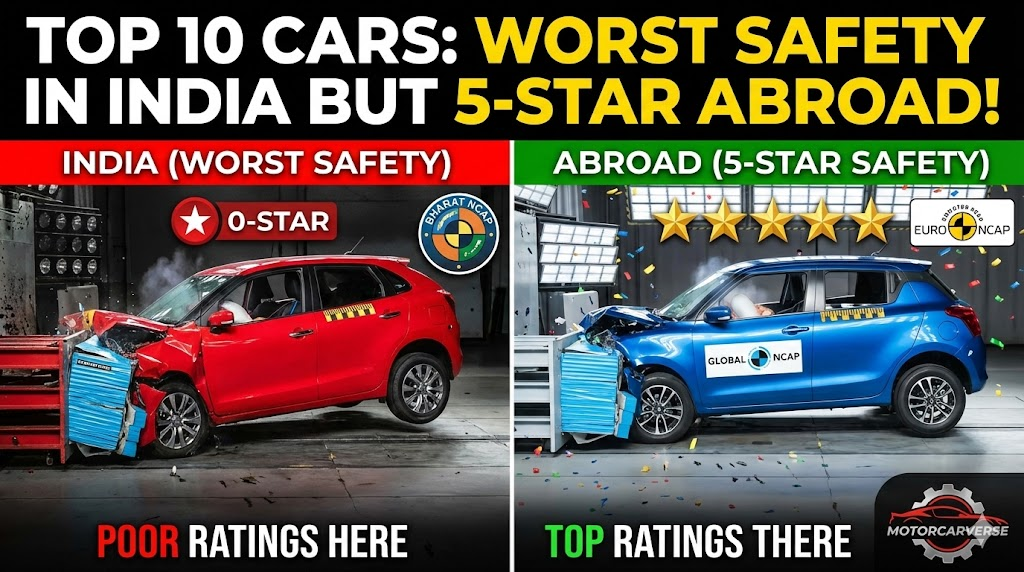
Many popular cars that rule Indian roads today have scored abysmal 0 to 3-star ratings in Global NCAP (GNCAP) crash tests. However, their international twins—sold in Europe, Australia, or the USA—often boast perfect 5-star ratings. Why? The difference lies in the steel quality, chassis reinforcements, and standard safety tech that are often deleted from the Indian models to cut costs.
At MotorCarVerse, we believe you deserve the full picture. Here are the Top 10 Cars that are safety champions abroad but safety laggards in India.
1. Kia Seltos
The Disparity: The Kia Seltos is the poster child of this phenomenon. In Australia (ANCAP) and the USA (NHTSA), the Seltos is a 5-Star fortress. In India, despite being a premium SUV costing up to ₹20 Lakhs, it managed only 3 Stars in GNCAP (2020), with its body shell rated as “Unstable.”
Why the Difference?
- Structure: The international model uses a higher percentage of Ultra-High Strength Steel (UHSS) in the A-pillars and chassis.
- Tech: The global Seltos gets ADAS (Advanced Driver Assistance Systems) as standard in many markets, whereas in India, it was introduced only in the 2023 Facelift (and the structure remains the same).
| Feature | India Spec (GNCAP) | Global Spec (ANCAP) |
| Safety Rating | ⭐⭐⭐ (3 Stars) | ⭐⭐⭐⭐⭐ (5 Stars) |
| Body Shell | Unstable | Stable |
| Airbags | 6 (Now Standard) | 6-7 Standard |
| ADAS | Level 2 (Top Trim) | Standard/Available |
2. Hyundai Creta
The Disparity: The undisputed king of Indian SUVs scored a mediocre 3 Stars in its GNCAP test. Contrast this with the Hyundai Creta sold in Indonesia/Malaysia, which scored a perfect 5 Stars in ASEAN NCAP.
Why the Difference?
- Platform Tweaks: While they look identical, the ASEAN-spec Creta demonstrated better structural integrity during the crash.
- Safety Assist: The 5-star rating abroad relies heavily on active safety tech (Autonomous Emergency Braking), which was missing in the pre-facelift Indian model. The 2024 Facelift brings ADAS, but the BNCAP score is yet to verify structural improvements.
| Feature | India Spec (GNCAP) | ASEAN Spec (ASEAN NCAP) |
| Safety Rating | ⭐⭐⭐ (3 Stars) | ⭐⭐⭐⭐⭐ (5 Stars) |
| Body Shell | Unstable | Stable |
| Standard Safety | 6 Airbags (New) | 6 Airbags + AEB |
3. Maruti Suzuki Swift
The Disparity: The Swift is loved for its peppy drive, but its safety record in India is dismal—scoring 1 Star (2022 GNCAP). Meanwhile, the Swift sold in Japan (JNCAP) scored 5 Stars, and the European model consistently scores 3 to 4 Stars (Euro NCAP).
Why the Difference?
- Weight & Steel: The European Swift is significantly heavier due to extra chassis bracing and side-impact beams.
- Active Safety: The Euro-spec Swift gets Radar Brake Support and Lane Departure Warning as standard, features that are just trickling into India now.
| Feature | India Spec (GNCAP) | Japan Spec (JNCAP) |
| Safety Rating | ⭐ (1 Star) | ⭐⭐⭐⭐⭐ (5 Stars) |
| Structure | Unstable | Stable |
| Weight | ~875 kg | ~970 kg |
4. Maruti Suzuki Ignis
The Disparity: Marketed as an “Urban SUV,” the Indian Ignis scored 1 Star in GNCAP. In Europe, the same quirky car scored 5 Stars (with Safety Pack) and 3 Stars (Standard) in Euro NCAP (2016).
Why the Difference?
- The “Safety Pack”: In Europe, the 5-star rating is achieved with a Dual Camera Brake Support system (AEB), which prevents crashes. The Indian version lacks this active safety layer entirely.
- Bodyshell: The Indian version’s footwell area was rated unstable.
5. Suzuki Baleno
The Disparity: The Made-in-India Baleno (previous gen) tested by Latin NCAP scored 0 Stars due to poor side-impact protection. However, the exact same car exported to Europe scored 4 Stars in Euro NCAP (with Safety Pack) and 3 Stars standard.
Why the Difference?
- Side Protection: The Euro-spec Baleno came with side and curtain airbags + stronger B-pillars as standard years before they were mandated in India.
- AEB: Again, the presence of Autonomous Emergency Braking boosted the European score significantly.
6. Hyundai i20
The Disparity: The stylish premium hatchback scored 3 Stars in GNCAP for India. Its European counterpart? A solid 4 Stars in Euro NCAP.
Why the Difference?
- Standard Kit: The Euro i20 gets 6 airbags, ESC, and seatbelt pretensioners as standard on the base model. In India, these were limited to top trims during the test (now improved to 6 airbags standard).
- Restraint Systems: The child safety score in the Indian i20 was lower due to the restraint system performance.
7. Renault Kwid
The Disparity: The Kwid revolutionized the entry-level segment but scored 0-1 Stars in repeated GNCAP tests for India. Surprisingly, the Brazilian-spec Kwid scored 3 Stars in Latin NCAP.
Why the Difference?
- Reinforcements: After the Indian Kwid failed, Renault reinforced the chassis of the Brazilian model, adding 13 kg of structural steel.
- Side Airbags: The Brazilian Kwid gets 4 airbags as standard, while the Indian version struggled with just one or two for years.
8. Maruti Suzuki S-Presso
The Disparity: The “Micro-SUV” scored 0 to 1 Star in India. However, the version exported from India to South Africa scored 3 Stars in Global NCAP (Africa protocol).
Why the Difference?
- Seatbelts: The South African model featured seatbelt pretensioners for the front passenger, which were missing in the Indian base model tested.
- Dual Airbags: The SA model had dual airbags as standard when tested, while the Indian base model had only one at the time.
9. Honda Amaze
The Disparity: The Made-in-India Amaze (previous gen) scored 2 Stars (2016) in GNCAP. The same car exported to South Africa scored 4 Stars (2019).
Why the Difference?
- No Structural Change: Surprisingly, GNCAP noted the structure was the same. The difference was largely due to the Seatbelt Reminder (SBR) and standard equipment levels which boosted the score in the newer Africa test protocol compared to the older Indian test.
10. Hyundai Grand i10 Nios (vs Euro i10)
The Disparity: The Indian Grand i10 Nios scored a poor 2 Stars in GNCAP. The European Hyundai i10 (which shares the platform but is shorter) scored 3 to 4 Stars in Euro NCAP.
Why the Difference?
- The “Grand” Compromise: To increase rear legroom for India (the “Grand” part), the wheelbase was stretched, but structural reinforcements to handle the extra length were seemingly not sufficient compared to the compact, rigid Euro spec.
- Electronic Stability: Standard in Europe, optional/absent in Indian base trims at the time.
Summary Table: The Safety Gap
| Car Model | India Rating | Global Rating | Key Missing Feature in India |
| Kia Seltos | 3 Stars | 5 Stars | UHSS Steel, Std ADAS |
| Hyundai Creta | 3 Stars | 5 Stars | Body Shell Integrity |
| Maruti Swift | 1 Star | 5 Stars (JNCAP) | Chassis Reinforcement, AEB |
| Maruti Ignis | 1 Star | 5 Stars (Euro) | AEB, Safety Pack |
| Renault Kwid | 1 Star | 3 Stars | 13kg Extra Steel |
Conclusion: Why Does This Happen?
The primary reason is Regulations and Cost. Until Bharat NCAP arrived in 2024/25, India lacked its own crash test standard. Manufacturers designed cars to meet the minimum legal requirement (which was low) rather than global best practices. In Europe or Australia, you cannot sell a car without ADAS and high structural integrity; in India, you can.
The Good News: Things are changing. With Bharat NCAP now live, manufacturers like Hyundai (Verna 5-Star) and Tata are setting new benchmarks. When buying a car in 2026, don’t assume a global brand name guarantees global safety. Always check the India-specific NCAP rating.
Disclaimer: Ratings mentioned are based on the latest available Global NCAP or Bharat NCAP reports for Indian models and respective international agencies (Euro NCAP, ANCAP, etc.) for global models.
Frequently Asked Questions (FAQs)
1. Is the Kia Seltos sold in India the same as the one in the USA? No. While they look similar, the USA-spec Seltos is built on a different platform (shared with the Kona) with higher usage of high-strength steel and comes with AWD and ADAS as standard. The India-spec Seltos uses the K2 platform (modified for cost) and scored 3 stars in crash tests.
2. Which is the safest car in India in 2026? Cars like the Tata Safari/Harrier, Tata Punch, Mahindra XUV 7XO, Skoda Kushaq, and Volkswagen Taigun are currently rated 5 Stars by Global/Bharat NCAP and are considered the safest.
3. Why did the Maruti Swift get only 1 star? The Indian Maruti Swift scored 1 star due to an unstable body shell capable of withstanding further loading, poor footwell protection, and a lack of standard side/curtain airbags (in the tested model). The European model is structurally different.
4. Are “Global NCAP” and “Euro NCAP” the same? No. Euro NCAP is much stricter and tests at higher speeds with active safety (ADAS) requirements. Global NCAP (for India/Africa) uses simpler protocols (though they are getting stricter). A 5-star GNCAP car might only be a 3-star Euro NCAP car, but a 5-star Euro car is almost always safer.
5. Does the new 2026 Hyundai Creta Facelift have a 5-star rating? The new Creta Facelift has not been officially rated by Bharat NCAP yet (as of early 2026), but Hyundai claims to have reinforced the structure. Until tested, its official rating remains based on the previous 3-star score.
