Why Traffic Police Doesn’t Allow Film On Mirror In Cars In India: The Complete Truth (2026)
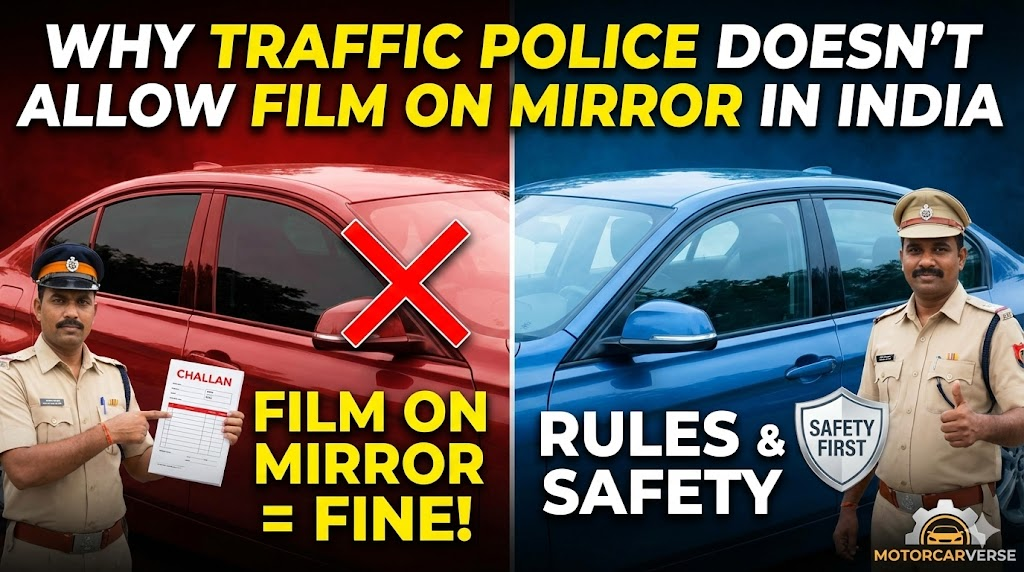
It is a common sight on Indian roads: a luxury car stopped by the traffic police, officers scraping off the dark black film from the windows, and the driver holding a hefty challan. For many car owners in a tropical country like India, where summer temperatures hit 45°C, this rule feels like a punishment. We all want to keep our cabins cool and protect our interiors from UV rays. Best 7 Cars with Best Resale Value in India 2026: Lowest Depreciation & High Demand
However, the ban on “Film on Mirror” (Sun Films) is one of the most strictly enforced regulations in the Indian Motor Vehicle Act. But why? Is it just to harass drivers, or is there a deeper reason? Top 10 Luxury Cars in India Under 50 Lakhs
At MotorCarVerse, we dig deep into the legal, safety, and technical aspects of Why Traffic Police Doesn’t Allow Film On Mirror In Cars In India in 2026.
The Legal Stance: It’s Not Just a Rule, It’s a Supreme Court Order
The primary reason traffic police are so strict about sun films is that they are enforcing a direct order from the highest court in the land.
In 2012, in the landmark case of Avishek Goenka vs. Union of India, the Supreme Court banned the use of all aftermarket sun films on vehicles.
- Before 2012: People could apply films as long as they met visibility standards.
- After 2012: The Court ruled that no material (film, curtain, or mesh) can be pasted on the safety glass after the car has left the factory.
The judgment clarified that the VLT (Visual Light Transmission) standards apply to the glass manufacturer, not the car owner. This means you cannot buy a clear glass car and paste a 70% visibility film on it. The film itself is the violation, not just the darkness.
Specifications & The “70/50” Rule Explained
There is often confusion between “Tinted Glass” and “Sun Film.” They are not the same. The Central Motor Vehicles Rules (CMVR), specifically Rule 100, lays down the specifications for visibility.
Permissible Visual Light Transmission (VLT) Limits
| Glass Area | Minimum Visibility Required (VLT) | Allowed Material |
| Front Windshield | 70% (Must pass 70% light) | Factory Glass Only |
| Rear Windshield | 70% (Must pass 70% light) | Factory Glass Only |
| Side Windows | 50% (Must pass 50% light) | Factory Glass Only |
The “Factory Fitted” Exception
You can have tinted glass, but it must be manufactured that way.
- Allowed: A car bought from the showroom with slightly green/dark glass (e.g., Maruti Baleno Alpha, Hyundai Creta SX) is legal because the glass itself is dyed during manufacturing to meet the 70/50 VLT rule.
- Banned: Buying a base model with clear glass and pasting a “0% tint” or “transparent UV film” at a shop is illegal.
Why the Ban? Safety & Crime Prevention
The ban wasn’t implemented to make your drive hotter; it was a response to serious societal issues. Here are the three main reasons why the Traffic Police enforces this ban:
1. Prevention of Heinous Crimes
This is the most significant reason. Before the ban, heavily tinted cars were frequently used for criminal activities, including kidnappings and sexual assaults.
- Dark windows allow criminals to move undetected through the city.
- Victims inside the car cannot be seen by the public or police outside.
- The ban ensures 100% visibility into the car, acting as a deterrent to crimes committed inside moving vehicles.
2. Police Visibility & Traffic Enforcement
Traffic police need to see inside your vehicle to enforce other laws.
- Seat Belts: If your windows are dark, cameras and officers cannot see if you or your rear passengers are wearing seat belts (which is mandatory in 2026).
- Mobile Phone Use: Tinted glass hides drivers using phones while driving.
- Weapon Smuggling: It allows police at check-posts to visually scan the vehicle for weapons or suspicious items without stopping every single car.
3. Road Safety & Night Driving
While films reduce heat during the day, they significantly reduce visibility at night.
- Pedestrian Safety: A driver with 50% dark film on the windshield might miss a pedestrian wearing dark clothes on a dimly lit Indian road.
- Eye Contact: Driving often involves making eye contact with other drivers/pedestrians at intersections. Dark films eliminate this non-verbal communication, leading to accidents.
The “Safety Glazing” Confusion: 2024-2026 Update
In late 2024 and 2025, there was some confusion due to a Kerala High Court judgment. The court interpreted an amendment to the rules suggesting that “Safety Glazing” (a type of plastic film) might be allowed if it meets the VLT standards.
However, be very careful:
- This ruling is technically state-specific unless adopted by the Central Ministry.
- In major metros like Delhi, Mumbai, and Bengaluru, the traffic police still enforce the Supreme Court’s total ban on aftermarket films.
- If you paste a “permissible” film and drive to another state, you can still be fined.
- MotorCarVerse Advice: Until the Ministry of Road Transport and Highways (MoRTH) issues a clear notification overturning the 2012 ban, assume all aftermarket films are illegal.
Fines & Penalties for Tinted Glass in 2026
In 2026, the fines for using sun films have increased under the amended Motor Vehicles Act. It is no longer just a ₹100 offense.
| Offense Type | Fine Amount (Approx.) | Action Taken |
| First Offense | ₹ 500 – ₹ 1,000 | Challan issued |
| Second Offense | ₹ 1,500 | Challan + Warning |
| Repeat Offense | ₹ 2,000+ | Possible License Suspension |
| On-the-Spot | N/A | Film Removal (Scraping) |
Note: Fines vary by state. In Delhi and Mumbai, the police often insist on peeling the film off on the spot, which can damage your defogger lines (rear windshield).
Legal Alternatives to Aftermarket Films
If you cannot use films, how do you beat the Indian heat? Here are legal ways to keep your car cool in 2026:
1. UV Cut Glass (Green Glass)
When buying a new car, opt for the Top Variant. Manufacturers like Maruti Suzuki (Baleno, XL6), Hyundai, and Toyota offer “UV Cut Glass” from the factory. This glass blocks up to 99% of UV rays and reduces heat without being illegally dark.
2. Magnetic Sunshades (The Gray Area)
You can use magnetic sunshades or mesh curtains.
- The Catch: They are legal when the car is parked.
- While Driving: Technically, obstructing the driver’s view with a mesh is also a violation. However, cops are generally more lenient with these than stuck-on films because they are removable. Tip: Remove the front window shades while driving to avoid trouble.
3. High-Performance AC
Ensure your car’s AC is serviced regularly. In 2026, many cars come with remote engine start (via apps like BlueLink or Adrenox), allowing you to cool the car 10 minutes before you enter.
Myths vs. Reality
Let’s bust some common myths surrounding car window films.
Myth 1: “I can use 0% tint (transparent) film for UV protection.”
Reality: Illegal. The Supreme Court ban covers “any material.” Even a clear film can change the shattering properties of the glass, which is a safety hazard during a crash (rescue becomes difficult).
Myth 2: “I have a medical condition/skin allergy, so I am exempt.”
Reality: No. The law does not provide exemptions for private citizens based on medical grounds. Only Z+ category security vehicles (VIPs) are legally allowed to use heavy tints.
Myth 3: “It improves AC efficiency, so it saves fuel.”
Reality: While true, the Supreme Court ruled that public safety (crime prevention) outweighs the individual benefit of fuel economy.
Conclusion: Don’t Risk It
The question of “Why Traffic Police Doesn’t Allow Film On Mirror In Cars In India” boils down to a simple trade-off: Your Comfort vs. Public Safety.
While the heat is undeniable, the law is strict. In 2026, with AI traffic cameras capable of detecting dark windows, escaping with a tint is harder than ever. The cost of the film plus the inevitable fines makes it a bad investment.
Our Advice: Stick to factory-fitted glass, park in the shade, and use your AC. Keep your windows clear, stay legal, and drive safe.
Disclaimer: Traffic rules are subject to change and state-level enforcement. Always check the latest notification from your local RTO.
Frequently Asked Questions (FAQs)
1. Is 70% visibility film allowed in India in 2026? No. While the rule states the glass must have 70% visibility, you cannot achieve this by pasting a film. The glass itself must be manufactured with that visibility. Any aftermarket film pasted on top is illegal, regardless of its transparency.
2. Can I use sunshades or curtains while driving? Technically, no. Using curtains or mesh shades while the car is in motion obstructs visibility and violates the rules. However, they are perfectly legal to use when the car is parked to keep the interior cool.
3. What is the fine for tinted glass in 2026? The fine typically ranges from ₹ 500 to ₹ 1,000 for a first offense, depending on the state. Police also have the authority to remove the film on the spot.
4. Does the rule apply to the rear windshield? Yes. The rear windshield must also maintain 70% visibility. Pasting dark films on the rear windshield is illegal and also dangerous as it hinders your view of traffic behind you.
5. Are there any RTO-approved sun films? No. There is no such thing as an “RTO-approved aftermarket film” for private cars. If a shop claims their film is RTO approved, they are misleading you. Only factory-fitted tinted glass is RTO approved.
